Henrik Fischer · 25 September 2026
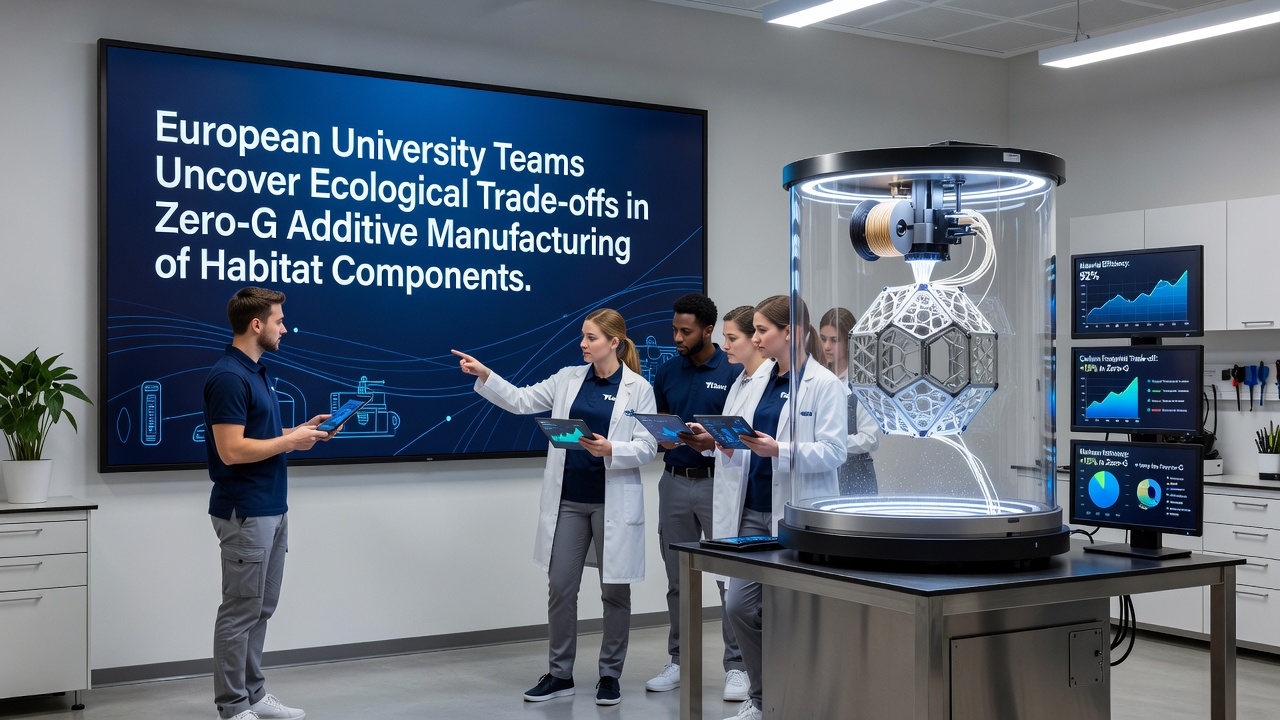
European University Teams Uncover Ecological Trade-offs in Zero-G Additive Manufacturing of Habitat Components
Teams from multiple European universities released findings in September 2026 that detail ecological trade-offs tied to zero-gravity additive manufacturing of habitat components, and these results emerged from coordinated experiments conducted aboard parabolic flight campaigns as well as ground-based simulators. Researchers at institutions including the Technical University of Delft, the University of Stuttgart, and ETH Zurich combined data on material usage, energy consumption, and byproduct generation while producing structural elements designed for orbital or lunar habitats. The studies compared processes carried out in microgravity against equivalent terrestrial operations, and the outcomes highlighted shifts in resource efficiency that arise once gravity no longer assists with powder containment or heat dissipation.
Experimental Setup and Data Collection
Engineers designed specialized printers that operated inside sealed chambers during short-duration weightless periods, and they tracked filament extrusion rates alongside power draw from onboard batteries. Data loggers recorded temperatures at multiple points on each printed truss and panel, while spectrometers measured volatile emissions released during polymer and metal deposition. Teams logged every gram of feedstock loaded before each flight and weighed residual material after the aircraft returned to stable flight, which allowed precise accounting of waste fractions that differ from Earth-based prints. According to records maintained by the European Space Agency, these flights occurred across six campaigns between 2024 and 2026, yielding more than 120 individual component builds that researchers later analyzed for structural integrity and lifecycle impacts.
Key Ecological Trade-offs Identified
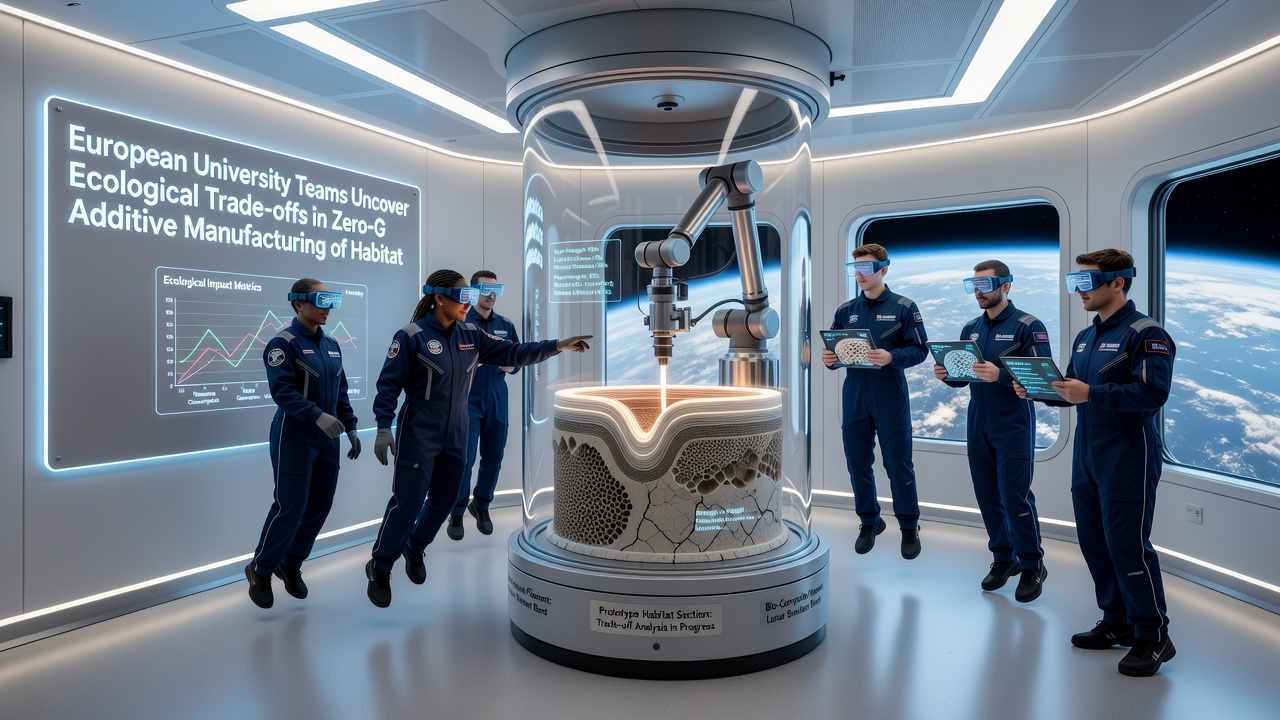
Material efficiency improved in microgravity because powders and melts remained suspended longer, which reduced the need for excess feedstock to compensate for settling; yet the same lack of sedimentation increased the volume of fine particles that escaped filtration systems and required additional capture equipment. Energy consumption rose by measurable margins during zero-g runs since printers needed continuous gas circulation to manage heat, whereas terrestrial machines rely partly on natural convection. Researchers documented a 14 percent average increase in electricity use per kilogram of printed titanium alloy when gravity effects were removed, and they traced much of that difference to active cooling loops and vibration dampers. Waste streams also changed character: on the ground, unused powder can often be sieved and reused with minimal treatment, but microgravity runs produced higher percentages of oxidized or agglomerated particles that demanded chemical reprocessing before any secondary application.
Comparative Lifecycle Assessments
Life-cycle models incorporated data from both flight and ground trials, and they factored transport emissions required to deliver specialized equipment to launch sites in French Guiana and Kazakhstan. The models showed that although in-space manufacturing can cut launch mass by consolidating multiple habitat parts into single prints, the added mass of filtration units and power storage systems partially offsets those savings. Figures released through the European Commission’s space research portal indicate that net payload reductions reached 22 percent for certain truss assemblies once all support hardware was included, yet total carbon-equivalent emissions across the full supply chain remained within 8 percent of conventional assembly methods when calculated through 2035 projections. Teams also examined water usage for post-processing steps such as surface finishing and noted that closed-loop systems tested in simulators reduced consumption by 35 percent compared with open terrestrial workflows.
Regional and Institutional Contributions
Groups at the University of Bologna contributed atmospheric modeling that predicted how exhaust gases from printers disperse inside pressurized modules, while colleagues at the Norwegian University of Science and Technology supplied statistical frameworks for uncertainty analysis across repeated builds. Cross-checks with datasets from the Canadian Space Agency confirmed similar patterns in energy overhead, and parallel work at the Australian National University examined regolith-based feedstocks that might eventually supplement Earth-supplied materials. These combined efforts produced a shared database released under open-access terms in late September 2026, allowing other laboratories to rerun simulations with updated parameters.
Implications for Future Habitat Design
Design guidelines derived from the studies recommend modular printer architectures that can switch between multiple feedstock types without full system purges, and they suggest integration of electrostatic precipitators sized specifically for microgravity conditions. Planners at the European Space Agency have incorporated several of these recommendations into preliminary specifications for a 2028 demonstration mission that will test continuous printing inside a dedicated orbital module. The database also flags certain polymer blends that release higher levels of volatile organics in the absence of gravity-driven mixing, prompting material scientists to explore alternative formulations before larger-scale production begins.
Conclusion
The September 2026 release compiled quantitative metrics on energy, material, and emission trade-offs that occur when additive manufacturing moves beyond Earth’s gravity well, and the resulting dataset supplies planners with concrete numbers rather than extrapolated estimates. Subsequent missions will test whether design adjustments identified in the university campaigns translate into measurable reductions in overall environmental load for sustained off-world operations.