Petra Ludwig · 2 September 2026
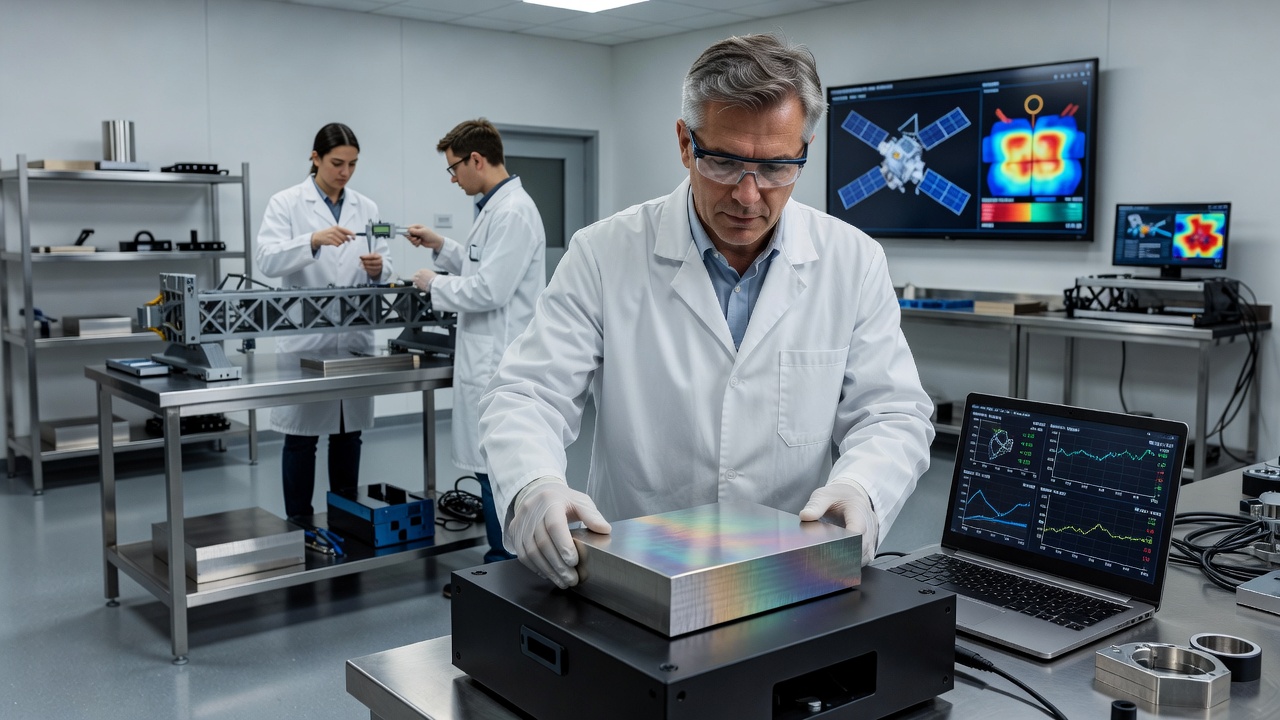
A research team at the Warsaw Institute of Advanced Materials has completed initial trials of a novel titanium alloy designed specifically for satellite structural components. The alloy, designated Ti-6Al-4V-ELI-OF, was processed using orbital forging techniques to achieve improved grain structure and fatigue resistance under orbital conditions.
Alloy Composition and Processing
The new material incorporates trace additions of niobium and zirconium to enhance creep resistance at elevated temperatures encountered during launch and re-entry phases. Orbital forging was performed at 950 degrees Celsius with a 12 percent reduction per pass, resulting in a uniform microstructure free of typical casting defects. Tensile tests conducted at the institute showed a 15 percent increase in yield strength compared with conventionally forged Ti-6Al-4V while maintaining elongation above 12 percent. Thermal cycling between minus 150 and plus 200 degrees Celsius revealed no measurable degradation after 500 cycles.
Metallographic examination confirmed refined alpha-beta phase distribution, which contributes to better crack propagation resistance. Researchers also performed high-cycle fatigue testing at 10 hertz under vacuum, simulating low-Earth orbit vibrations. Specimens endured more than 10 million cycles at stress amplitudes 20 percent higher than baseline aerospace titanium grades before failure. X-ray diffraction analysis verified residual stress levels remained within acceptable limits for satellite frame applications.
Performance Validation and Future Applications
Finite element modeling of a representative satellite bus frame indicated a potential 8 percent mass reduction without compromising stiffness requirements. The Polish team collaborated with the European Space Agency to validate these predictions through vibration and thermal-vacuum chamber tests scheduled for early next year. Preliminary data suggest the alloy could extend operational life of low-cost CubeSat platforms by reducing structural fatigue.
Further work will focus on scaling the orbital forging process to larger billets suitable for medium-class satellite structures. Industry partners have expressed interest in licensing the alloy once full qualification under ECSS standards is achieved. The institute plans to publish detailed mechanical property datasets later this quarter to support broader adoption in European space programs.