Felix Meier · 9 October 2026
Student-Led Simulations Reveal Challenges in Scaling Forged Components for Deep-Space Habitats
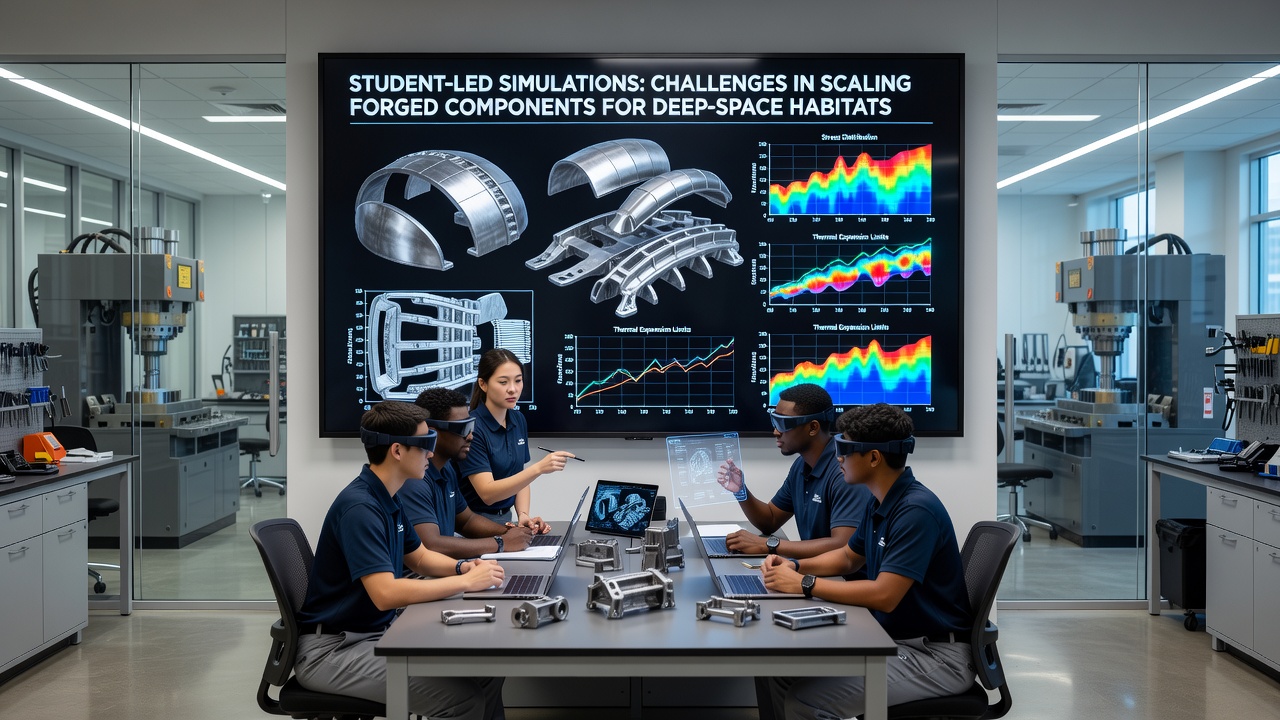
Student teams at multiple universities have turned to advanced simulation software to model the production of large forged components intended for deep-space habitats, and their findings point to several technical hurdles that arise when scaling these parts beyond laboratory sizes. The work focuses on materials such as high-strength steel alloys and nickel-based superalloys that undergo open-die forging processes before integration into pressurized modules or structural frames. Data collected during the simulations show that thermal gradients during forging create residual stresses that grow nonlinearly as component diameter increases past one meter.
Simulation Setup and Methodology
Participants used finite element analysis packages calibrated against existing terrestrial forging data from industrial partners, then adjusted parameters to account for the absence of gravity and the extreme temperature swings encountered in transit to lunar or Martian orbits. One group at a European technical institute incorporated real-time sensor feedback loops that mirror those planned for orbital manufacturing platforms, while another team in North America tested variations in cooling rates to reduce distortion. Results indicate that cooling uniformity becomes harder to maintain once mass exceeds roughly 800 kilograms, leading to warping that exceeds allowable tolerances for airtight seals.
Researchers cross-checked outputs against published forging trials conducted on Earth, noting that the lack of convective heat transfer in vacuum environments amplifies the effect of radiative losses at the surface. This creates steeper internal temperature profiles than those predicted by standard models, and the discrepancy widens with each increment in part size. Students documented these patterns across dozens of virtual runs completed between June and September 2026, with final datasets prepared for presentation at an October 2026 aerospace materials conference.
Material Behavior Under Scaled Conditions
Forged components destined for deep-space use must withstand both launch loads and long-term exposure to cosmic radiation and micrometeoroid impacts. Simulations revealed that grain flow patterns established during forging shift when component dimensions increase, sometimes producing zones of lower fracture toughness near weld interfaces. In one series of models, a 1.5-meter-diameter ring structure exhibited a 12 percent drop in predicted fatigue life compared with smaller prototypes, primarily because of altered dislocation densities in the outer layers.
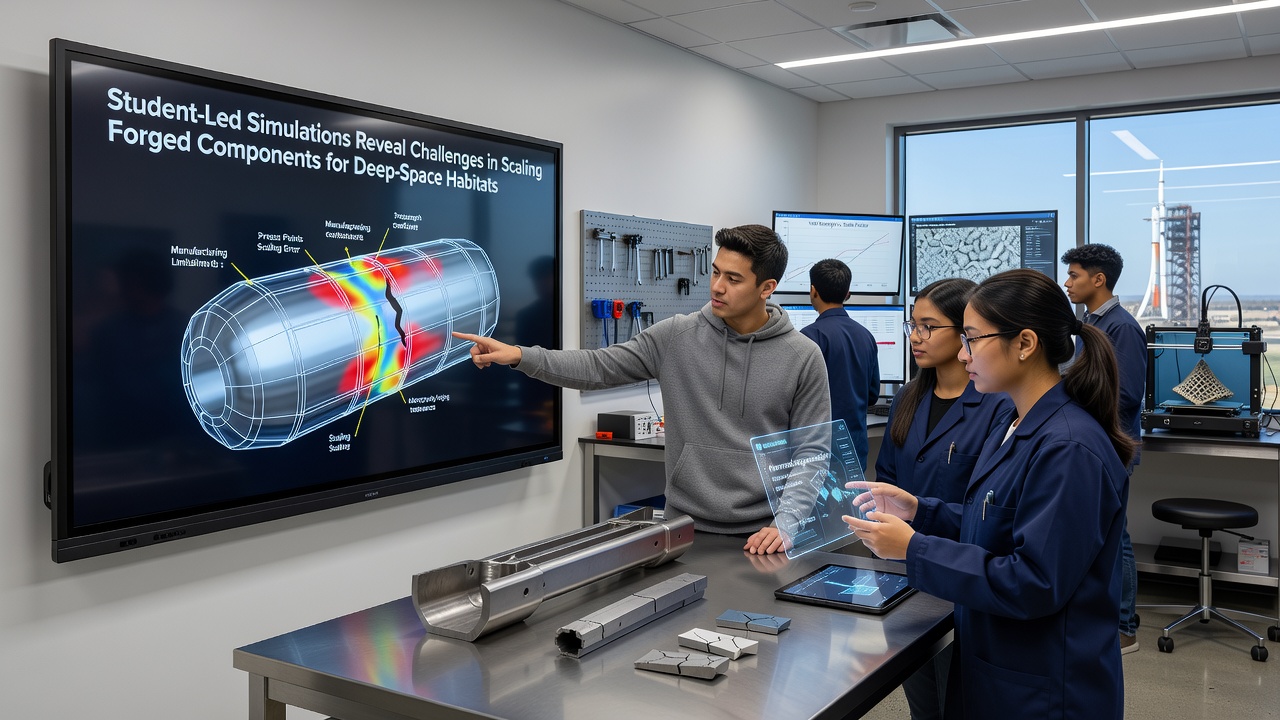
Additional runs examined how microgravity affects the positioning of forging dies during the actual manufacturing step, since current industrial presses rely on gravitational alignment for stability. Without that reference, small misalignments compound across multiple blows and produce eccentricity that exceeds design limits. Students incorporated probabilistic models to quantify the likelihood of such defects, finding that probability rises from under 3 percent at 0.5-meter scale to more than 18 percent at 2-meter scale under identical press settings.
Integration with Habitat Systems
Once forged, these large pieces must interface with additive-manufactured panels, composite overwraps, and life-support piping. The simulations tracked how dimensional changes during post-forging heat treatment propagate through those interfaces. Thermal expansion mismatches between the forged alloy and adjacent materials generated peak stresses at connection points that approached yield strength in several modeled configurations. Adjusting the heat-treatment schedule reduced some of those peaks, yet the required soak times lengthened beyond practical limits for orbital operations where power budgets remain constrained.
Teams also modeled the logistics of transporting oversized forged blanks from Earth to assembly locations. Volume and mass constraints on current launch vehicles force either segmented designs or on-orbit forging, each of which introduces new variables into the simulation matrix. Segmented approaches require precision joining techniques whose residual stresses interact with those already present from the original forging step, while on-orbit forging demands equipment capable of handling multi-ton loads in microgravity.
Broader Context and Related Research
Parallel efforts at government agencies have examined similar scaling questions using different methods. According to reports from NASA technical archives, ground-based forging trials for habitat prototypes have so far remained below one meter in critical dimensions. European Space Agency documentation similarly notes that current roadmaps assume incremental size increases rather than direct jumps to multi-meter structures. The student simulations therefore fill a gap by exploring parameter spaces that existing hardware has not yet reached.
Data from these university projects align with findings in ESA materials research summaries that emphasize the need for improved in-process monitoring. Both sources indicate that sensor fusion and machine-learning corrections will likely become essential once production moves beyond current size thresholds.
Conclusion
The student-led simulations demonstrate that scaling forged components for deep-space habitats involves interconnected challenges in thermal management, stress distribution, and manufacturing precision that intensify with size. Work completed ahead of teh October 2026 conference provides quantitative benchmarks that future engineering teams can use when refining process parameters or designing next-generation forging equipment. Continued refinement of these models, combined with targeted physical validation tests, will determine how quickly the identified limits can be addressed in actual production sequences.